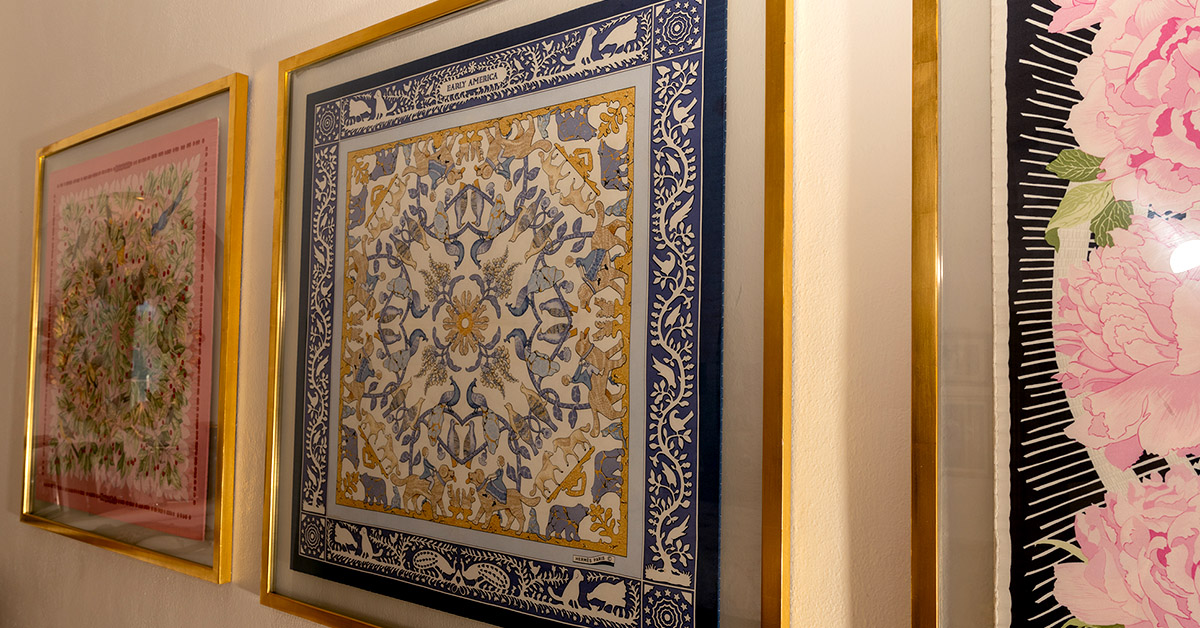
 A collector of authentic Hermes Carre Foulard silk twill hand-colored scarves frames them for her wall. Others she keeps in their distinctive slim orange boxes. By 1937 Hermes designed for Elizabeth II, Jacqueline Bouvier, and Grace Kelly. The collector sent me a photo of a themed non-PC 1950s Tiajuana scarf. She asked about the history of the themed scarf.
My client collects of all things scarves, not only Hernes—her top valued collection. She also collects vintage souvenir scarves, including a 1950s rayon version from Tijuana with raised glitter. From the sublime to the ridiculous!
I married a Brit in 1979
My posh British mother in-law, who always wore a silk square knotted under her chin, gave me a Jacqmar silk square, a Moulin Rouge Lautrec image, as a shower gift. From today‘s research I learned that early 20th century Londoners Jack and Mary Lyons (Jac-Mar) produced wartime political advertising, propaganda, and souvenir scarves. Thanks goes to Jack and Mary’s association with Clementine Churchill, Winston’s wife, for whom they designed a WWII Royal Air Force scarf: “Happy Landings.” Jacqmar propaganda scarves took off. In a 1942 issue of Vogue every celebrity wore a British designed WWII be-sloganed silk scarf.
In 1941 Nazi forces invaded France, once the leader in such accessories since Hermes created their first scarf in 1923. The British design alternative Jacqmar featured British wartime slogans: “Salvage Your Rubber!,” Switch Off That Light!,” the “Free France Flag,” and “Welcome American Forces in London.”
An Emblem of Solidarity
Jacqmar sourced silk from used wartime parachutes. With silk in short supply they made headscarves from crepe or rayon with metallic glitter accents. We see this on the Tijana scarf post war. Instead of fine hand rolled hemming, cheaper scarves came machine hemmed and be-sloganed with wartime advertising gimmicks, colorful and cheap, opposed to the expensive fine Jacqmar silk squares.
In the war years of 1940s and early 1950s silk scarves became a female emblem of solidarity and frugality. Campaigns such as ‘Rosie the Riveter’ boasted images of headscarves on working factory women. “Cover Your Hair” became a propaganda scarf, to prevent long hair caught in machinery.
The themed scarf, what we think of as a WWII fashion, became a tradition in clothing thousands of years before. In pictures we see Egyptian Queen Nefertiti with a scarf around her slim neck. Portraits from Greece in 500BC show men draped in scarves, called in Latin ‘sudarium,’ or catch the sweat. A close relative of the necktie, these scarves took a stopover in 17th century Croatia of all places. Croatian soldiers sent to France as mercenaries in the 18th century wore silk scarves emblazoned with their rank.
The fashion took off among soldiers who termed the scarves “cravate,” French for “Croat.” During the French Revolution patriots wore the Tricolor scarf. On his African campaign Napolean collected silk Egyptian scarfs for Josephine. In the little town of Paisley, Scotland weavers designed wool scarves for British women from Middle Eastern designs. These scarves were exported throughout US and Europe in the late 19th century.
Scarfs are important liturgical vestments, and academic standards, not to mention themed scarves for Oddfellows and Foresters, Football fiends, and Scouts.
The World of Themed Scarves
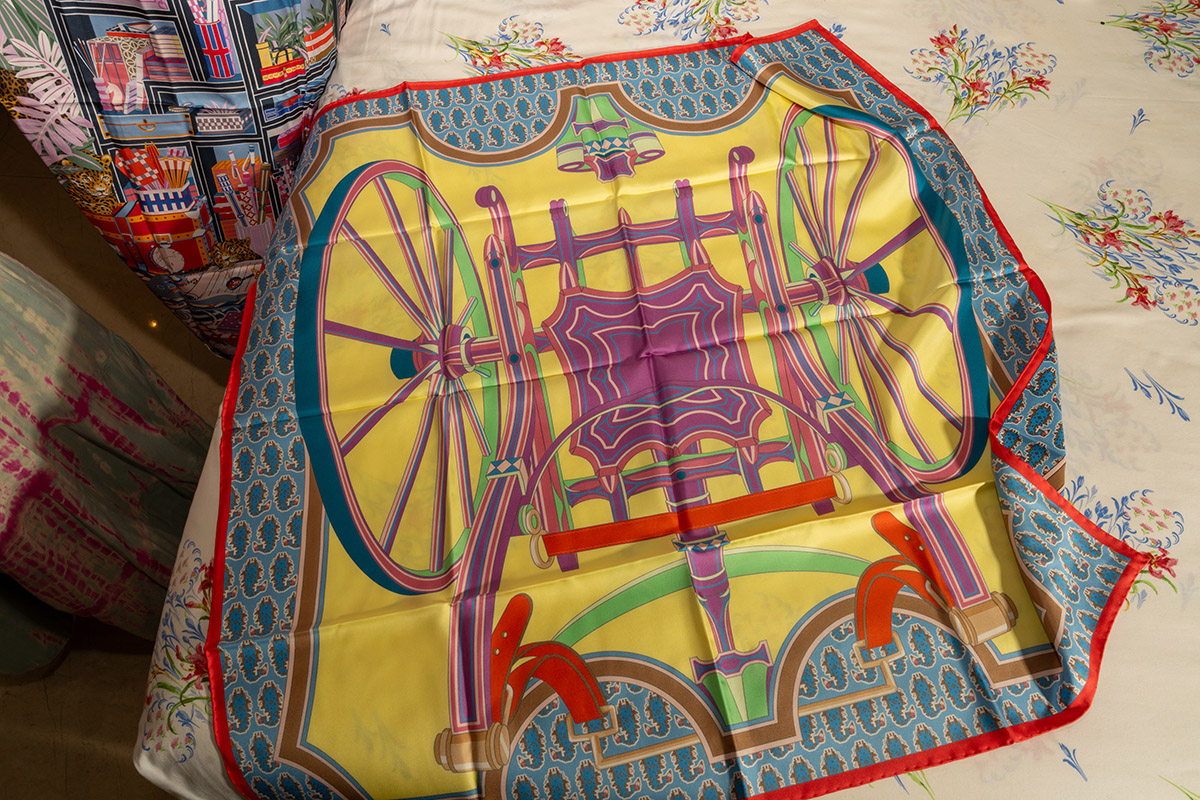 A certain famous Hermes scarf changed the world of themed scarves. The second generation of the Hermes family created “Jeu des Omnibus et Dames Blanches” of 1923. Founder Thierry Hermes (1801-1878) was a saddlery, bridle, and harness maker associated with the horses of the courts of Napoleon III and Queen Victoria. He branched out to “equipage,” trunks, bags, jockey’s silk blouses, and handbags with patented zipper clasps.
By the second generation of Hermes, the colorful classy jockey’s blouses developed into scarf squares for women. Hermes modeled further scarves on French soldiers in battle on horseback or in military dress on China silk. This required forty-three screens, each a different color, to create a wonderful pallet. I’m proud that I own six or so thrift store Hermes scarves. Hermes International as of 2013 is in the hands of the sixth generation under Axel Dumas.
My client’s Mexican scarf is valued at $40 on the nostalgia market, and a good vintage Hermes scarf runs into the thousands.