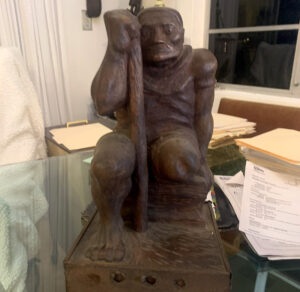
 At the Boys & Girls Club, my favorite thrift store in Ventura, I found an ugly Brutalist folk art style wood carving. This one-legged man sits with a cane. For years I searched for the carver. Everyone who comes to my house says it’s the ugliest thing they’ve ever seen. I tend to pick up “orphans”—ugly art from thrift stores with no signatures.
How did I find the artist? Years ago a high school friend leased a flat on Bleecker Street in NYC from a developer who saw the potential in The Village in the 1970s. When developer Ira Weissman died in 2023 my high school friend, who befriended him, inherited a naïve-art woodcarving in the mid-20th century folk-art style carved by Ira. When my friend sent me a photo of this work asking for an opinion of value, the work looked like my ugly thrift store find.
I learned Weissman considered the Swedish sculptor Emil G. Janel (1897-1981) his mentor. Janel, after a long career in California, became known for his Brutalist caricatures in the Scandinavian style of woodcarving. The Maxwell Galleries of the American Swedish Institute, located in the Phillips West neighborhood of Minneapolis, contains thirty-five carving by Janel, donated by Ira Weissman. Bingo. In Ventura I discovered a Swedish style naïve wood folk carving done by a 1920s immigrant to California.
l970s Tradition of Handmade Crafts
Janel received the Royal Order of Vasa for his unique technique from the King of Sweden in 1965. He owned a summer house in the 1930s on the Russian River. There he gathered alder wood, which he soaked in a bucket to keep the medium wet. To Janel, wet alder wood seemed like living flesh. The artist termed the slightly grotesque folk art carvings “exaggerated realism.” Janel’s work fits nicely into the l970s tradition of handmade crafts, a direct reversal of austere Scandinavian design, angular and clean, which predates the 1970s crafts revival.
The 1970s revolution in craft and folk art turned away from American mass-produced culture. The art world discovered the true expression of a person was creativity, shown by a handmade work of art. Especially for an artist with no formal training. Remember the early 1970s Isley Brother’s hit: “It’s Your Thing; Do What You Want to Do! I Can’t Tell you Who to Sock it To…”
Museums began to realize ‘artifacts’ and ‘artisans’ were indeed ‘art’ and ‘artists,’ blurring the lines between fine art and craft. For example, the founding of the American Folk Art Museum on Lincoln Square in NYC, dedicated to folk and self-taught artists. Those like the Swedish American Janel, made art as an expression of individuality. A subtle political message lurked behind this movement, eschewing machine-made, post WWII furniture and décor, and turned towards “outsider” art. Unconventionality, as far from mainstream as possible, was imaged as statement of uniqueness.
Non-Educated Creatives
The field of authentic, a difficult term to define, American folk art was only a ‘field’ after the mid-20th century. Self-taught art became synonymous with American individualism, the strong influence from the counterculture and social movements that shaped this decade. The early 1970s began a legacy of respect for non-educated creatives of all kinds (poets, musicians, woodworkers, shaman, dancers) whose craftsmanship, artistic identity, brought ‘craft’ into the broader art world. If not for the ‘self-taught’ revolution of the 1970s thirtysomethings wouldn’t become experts after reading an AI Google search. We trust non-experts because of the “self-taught” revolution of the 1970s!
Many of Janel’s works were sold as “folk,” “outsider,” or “self-taught naïve” art. I notice his human figured sculptures sold in both California and Swedish auction houses in the 2020, as he’s been rediscovered today. Closely resembling my “lame” man, Janel’s “Bodybuilder” is equally imposing, and sold at Toomey Auctions estimated at $1k-2k. An old gentleman perched on a toilet at five inches tall sold for $1,747 in Stockholm Anktionsverk, a dapper but ugly “Gentleman with Walking Stick” sold for $5,250. A carving created in 1922 called “Skalvridning” (twisting the bowl) at eight inches high, showing two-figures holding a massive bowl, sold at Stockholm’s most famous auction venue, Bukowski’s for $8,400.
Thus my “outsider” folk art in the Swedish caricature tradition, found in Ventura at the Boys & Girls Club Thrift Store, is worth $4,000. Ugly, sure, but, to me, interesting and emblematic of the 1970s, weird, folk craftsmanship revolution.
Let me know in the comments below what YOU found in local thrift stores.
Love your story, your search….your find! What a wonderful journey to land the identity of your Brutalist sculpture…and tell to tell us!
Love M